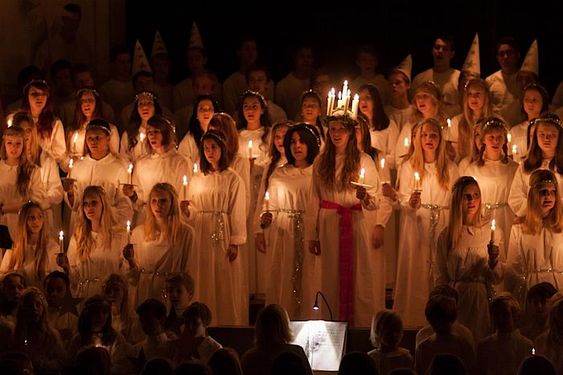
Lucia – Saint Lucy’s Day
Lucia is a beautiful holiday in Sweden that takes place on December 13th. It is one of the most beloved Swedish customs, where girls and boys dress in stunning white full-length gowns and sing songs together.
It is a tradition for Lucia to wear a crown of candles (electric or real ones) in a wreath on her head. Her handmaidens also carry candles, and the star boys carry stars on sticks while having tall paper cones on their heads. The Christmas elves follow along, carrying small lanterns.
There used to be a competition for the role of Lucia on national level, but now schools and others organize a draw, since it is such a popular position.
This wonderful tradition represents the life in the Swedish peasant communities of old – darkness and light, cold and warmth.
On the morning of Lucia Day, the radio has choirs or groups coming by and sing the standard Lucia song.
Typical for Lucia is to celebrate with yummy gingerbread biscuits and sweet saffron-flavoured buns (lussekatter) shaped like curled-up cats with raisin eyes, which go perfectly with glögg or coffee.

Did you know that the Lucia tradition has a fascinating history?
It is said to have origin from both St Lucia of Syracuse, and the Swedish legend of Lucia as Adam’s first wife. While its exact origins are unclear, the name is associated with both “lux” (light) and Lucifer (Satan). Today’s Lucia celebrations are a combination of several traditions.
In the old almanac, Lucia Night was the longest of the year, and people believed supernatural beings were abroad. The creatures and the people needed extra nourishment, and those who slept in were nicknamed “Lusse the Louse.” In agrarian Sweden, young people dressed up as Lucia figures and went from house to house singing songs.
The first appearance of a white-dressed Lucia was in 1764, but the custom didn’t become popular until the 1900s. The Lucia procession became a more acceptable form of celebration compared to youthful carousals of the past. Stockholm proclaimed its first Lucia in 1927, and the custom of serving coffee and lussekatter dates back to the 1880s.